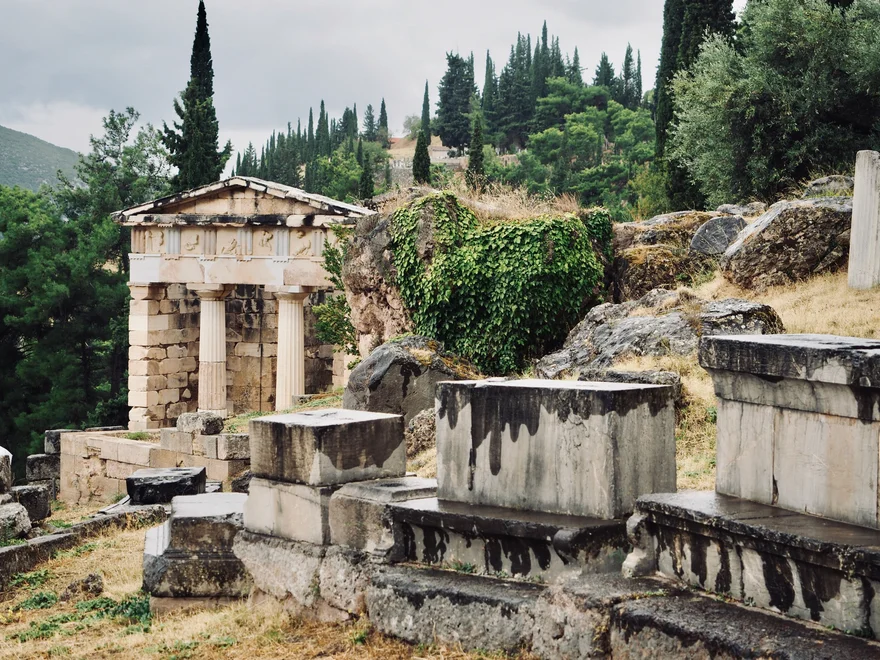
At Delphi, I eavesdrop on a guided tour. It happens. You are standing somewhere, a guide says something interesting, and suddenly those stones need a little longer to appreciate.
This time it is the Delphic maxims. The guide gives their precise number and talks about “Know thyself”. It sounds weighty. We are in Delphi, after all. You do not come here expecting tips for a Tuesday morning.
In my mind, a neatly ordered collection of wisdom takes shape, as much a part of this place as the temple and the oracle. A sort of instruction manual for life, published under divine supervision.
I read up on it. Before long, I am thinking of greeting cards.
First, sort out the stones
My reading starts by separating two things. Ancient writers describe the famous sayings at the Temple of Apollo, including “Know thyself” and “Nothing in excess”. The familiar collection of 147 maxims, however, comes down to us through the late-antique writer Stobaeus. It is not a set of 147 inscribed stones dug up at Delphi.
Pausanias says the Seven Sages dedicated their sayings to Apollo. Other people bring valuables; the sages bring a good line.
I am still thinking of greeting cards.
Then I read the sayings.
That would fit on a mug
“Control your anger.”
Good advice. Especially just before sending a message. As a notification on your phone, it might arrive in time. On a stone in a Greek sanctuary, you would have to remember it for later.
“Control your spending.”
That is in the surviving collection too. I had expected Delphi to address life’s great questions. Now we are doing the household budget. Something to print on a gift card if you want to save yourself the cost of a present.
“Accept old age.”
Only recommended for birthday cards where the friendship is robust. At our age, I would pause before sending it and consider whether I would enjoy receiving it myself.
“Never tire of learning.”
We can use that one for graduation. Retirement too. A few well-chosen pieces of wisdom will cover a surprisingly large proportion of family occasions.
I picture the lines on cards, on calendar pages, between two breathing exercises in a self-care app. They fit effortlessly. Add a sunrise and a friendly typeface. Done.
Of course, the advice has not yet been followed. I doubt a stonemason could solve that problem either.
Great wisdom, small tasks
“Know thyself” could keep you busy for a lifetime. “Control your spending” sounds like a more manageable assignment. I like that both belong to the same tradition of wisdom.
As I read, antiquity loses a little of its solemn remoteness. People were supposed to manage their anger, keep hold of their money and accept getting older. We could transfer the reminders straight to our phones. The demands would be familiar. Following through would still be a nuisance.
The ancient collections are not, of course, an unchanged handbook for modern life. They also contain rules reflecting a society we would not wish to reproduce. But among those unfamiliar instructions are some remarkably familiar demands.
Our continuing need for the same reminders does not say much for our capacity to learn. It does, however, explain the market for calendars.
A line to take away
Angie and I collect short phrases that help us too. From a book, a yoga workshop, even an Instagram post. A sentence need not contain an entire philosophy to set something in motion at the right moment.
We try to put life into a form we can remember. A little order amid the muddle. A hint about what to do next.
At Delphi, the place and the age of a saying lend it extra weight. I read it differently from the same words on a mug beside the coffee machine. Although “Control your anger” might be particularly useful there.
I could go on about the other maxims. But one of Delphi’s best-known sayings is:
“Nothing in excess.”