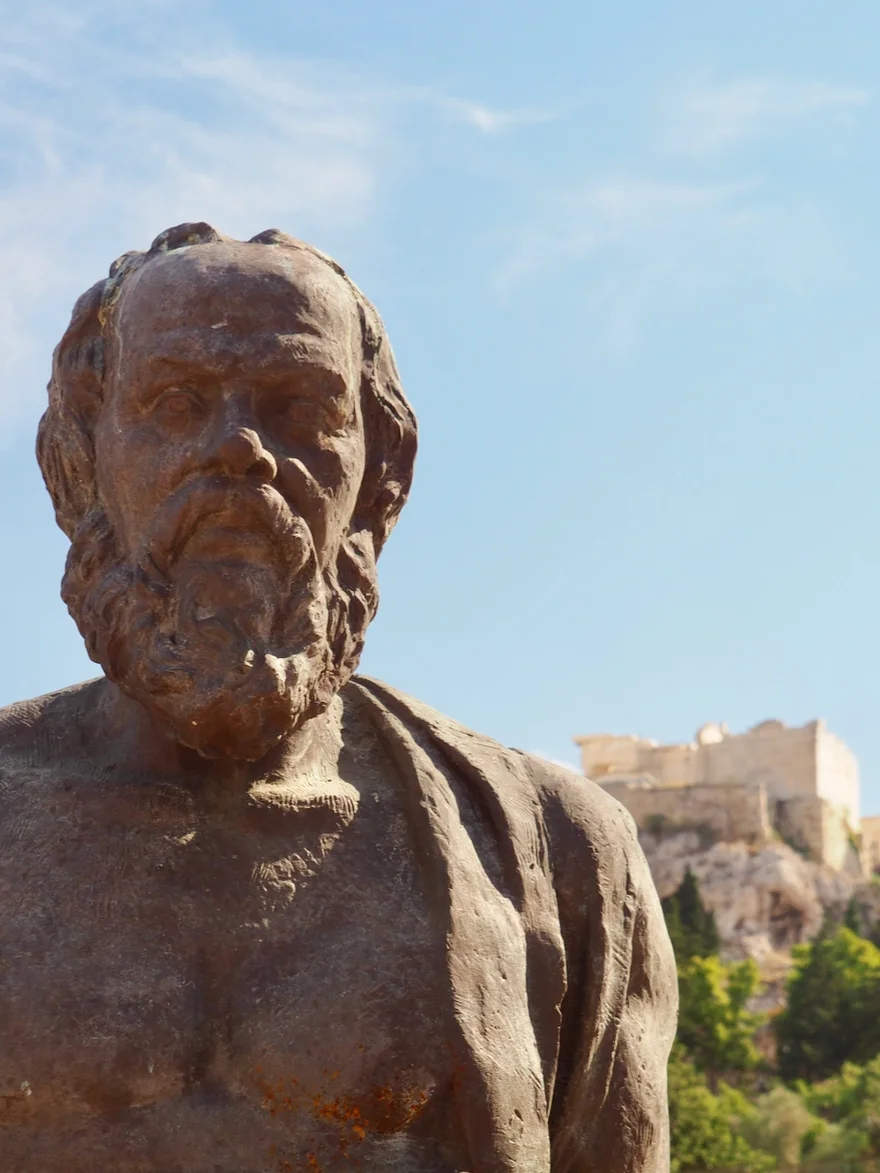
In the ancient Agora, I read about the people who took on political duties here. And wonder: what if it were my turn?
What if I put myself forward, my name was drawn, and I had to serve on the council for a year?
“The cradle of democracy” is a phrase we have heard several times on the Acropolis. We pick up these explanations when we happen to stand beside a tour group. In Athens, it is part of the standard repertoire. It sounds solemn, and you feel you know what it means.
Down here, it becomes more concrete. And more demanding.
Work was done here
The Acropolis was the city’s religious and symbolic centre. Its political work is easier to grasp elsewhere. The Agora housed, among other things, the council building and facilities for administering justice. On the Pnyx, citizens gathered to debate and vote.
Walking through the Agora, I notice how much we read into that familiar word. Parliaments, parties, election campaigns. People we elect to represent us.
The Athenians organised their democracy differently. Eligible citizens could decide matters themselves in the Assembly. Many offices were filled by lot, others by election. Council members did not belong to a parliamentary party that had just fought its way to a majority.
Only eligible men had a political voice, though. Women, enslaved people and resident non-citizens were excluded. Angie would have had no vote in the Assembly.
Your name comes up
I am especially struck by the Council of Five Hundred. Its members were selected by lot for a year. They prepared the Assembly’s business and handled the city’s ongoing affairs. The council met regularly — in principle, every day except festivals.
For a year. That would have consequences for your diary.
At first, drawing lots seems an odd way to decide something so important. Surely we choose people we trust to do the job. People who persuade us. Who are supposed to understand the problems.
In Athens, democracy also meant distributing political duties among citizens and taking turns. Drawing lots was one way to do that. Political responsibility did not have to fall only to those who could win an election.
I imagine what taking on those duties would involve. Getting to grips with matters that had barely interested me before. Listening to others. Understanding an issue well enough to make a decision. And coming back the next day.
Democracy here had a very tangible appetite for time and work.
We vote. You do the work.
Our representative democracy takes much of that work off our hands. Sensibly enough. I do not want to negotiate every budget question myself.
But I also recognise the attitude: we have made our choice. Now let the elected people get on with it.
We have outsourced politics.
As a division of labour, that is accurate. As a frame of mind, it can become rather comfortable. We expect results, judge performance and complain when it falls short of our expectations. At the next election, we can hire someone else.
The thought that we might contribute something ourselves in the meantime slips more easily out of view. I can form an opinion faster than I can understand an issue. And pointing out what others are doing wrong fits neatly between two appointments of my own.
What is taking so long?
In the Agora, I also think about the time between a question and a decision. About people with different interests discussing, disagreeing and somehow having to reach a result.
From the outside, what you mostly see is how long it takes.
I want decisions to be well prepared and to take their consequences into account. I want those affected to be heard. And I want something to happen at last. These wishes do not always sit comfortably together.
If I leave all the work of reaching a shared decision to others, I can easily lose sight of what it requires. A difficult judgement starts to look like incompetence; disagreement looks like nothing more than squabbling.
That does not mean I cannot criticise a government. What concerns me is how carefully I have examined the things I feel so certain about.
After casting a vote
Here in the Agora, the solemn phrase becomes something rather practical. Democracy needs people to take on tasks, learn what they need to know and turn up again.
Many people do that work today: in parliaments and local councils, in community groups and everyday political life. But even without holding office or joining anything, there is work to do. Taking an issue seriously. Examining arguments, including uncomfortable ones. Trying to understand which interests collide, and why a decision that seems simple to me may not be simple for someone else.
I do not have to agree in the end, or be happy with the outcome. But I would like to know more precisely what I am criticising.
That democracy takes work makes immediate sense here. The harder question is how much of that work I am prepared to take on myself.