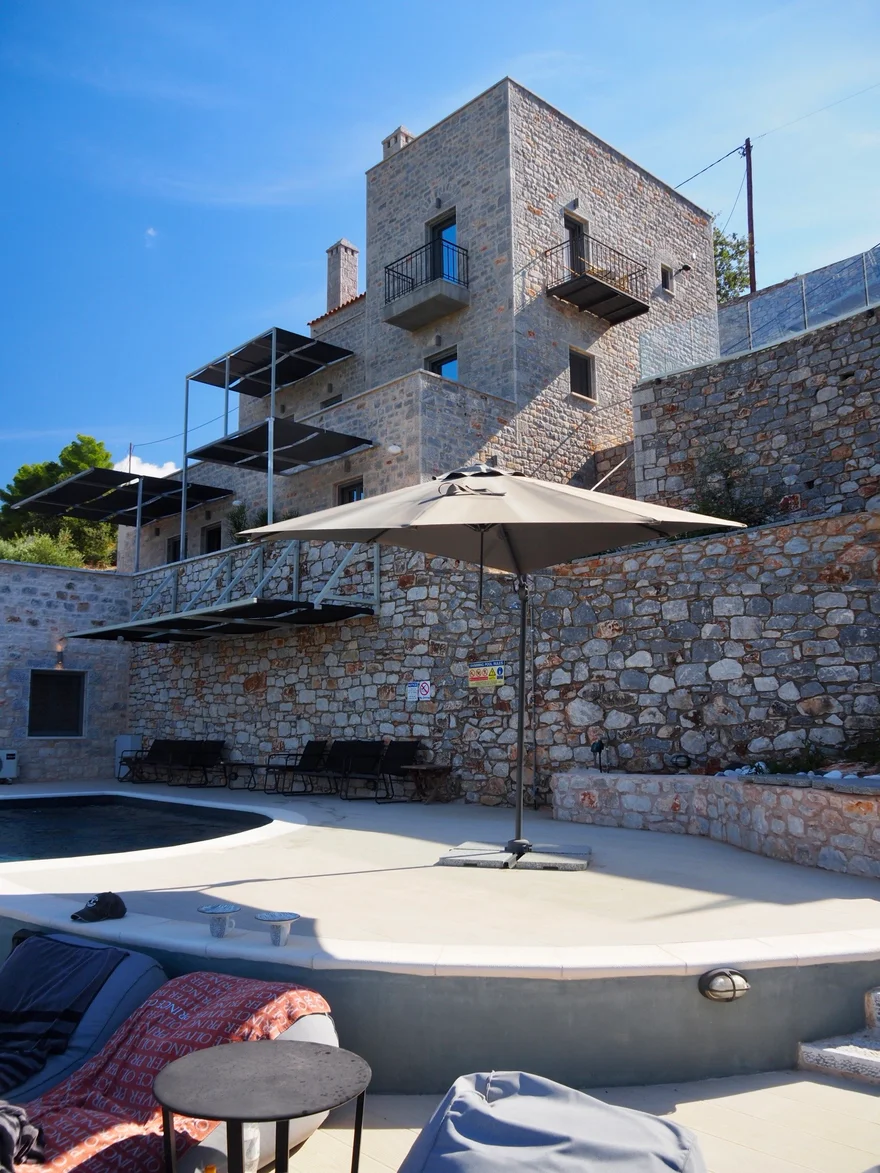
Our Airbnb sits above Limeni Bay, on the road to Areopoli. The complex steps down the hillside, with two pools and glass balustrades designed to interrupt as little as possible of that extraordinary sea view. The house itself looks like a small, square tower.
We park and go inside. Everything is modern, beautifully equipped and tastefully furnished. I am delighted and try to put that into words. Angie agrees.
“It’s dark in here,” she says.
Plenty of view, not many windows
She loves light rooms. Big windows. Especially when we are by the sea. I look around and have to agree. A small window, narrow openings with wooden shutters. Even the door to the huge terrace is only about shoulder-width. Outside, they have installed glass balustrades so the eye can roam freely across the bay. Inside, it first has to find a way out.
We leave it there. It is getting dark anyway, and the apartment really is lovely.
The next morning, we set off into the Inner Mani. I drive; Angie reads aloud from the guidebook. Including the chapter on tower houses.
Love thy neighbour
The towers belong to a history of families, clans and feuds. Fall out with another family here, and the hostility could extend far beyond the original quarrel and those directly involved. Blood feuds. To me, that phrase belongs to a distant past. Or a gangster film. In the Mani, such conflicts still shaped life in the nineteenth century.
The towers offered protection while allowing their occupants to fire on their enemies. Thick walls, small openings, arrow slits. A view of the house next door could have a decidedly practical purpose.
We think of our holiday apartment.
We do not know whether our house is new or superbly restored. We suspect it is new. But now we notice the architectural family resemblance: the compact shape, the small openings. What we saw last night as an unfortunate combination of beautiful architecture and limited daylight acquires a history.
And suddenly we see towers everywhere.
A beautiful village to be afraid in
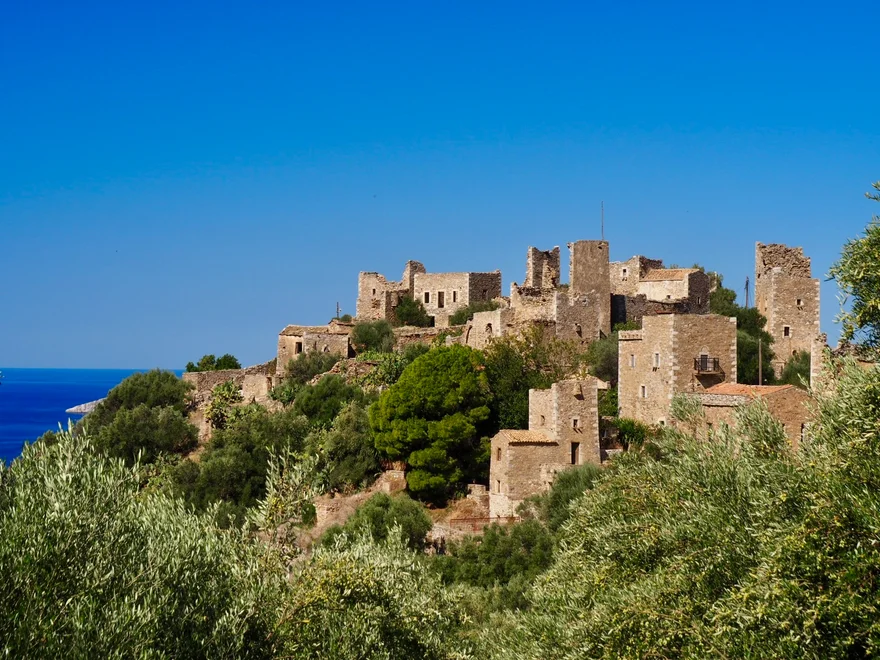
At Vathia, they form a particularly striking group. Stone on an exposed hilltop, houses and towers tightly packed. The village looks largely deserted to us. The sort of place that makes you reach for the camera from a distance.
The longer I think about what Angie has read, the less comfortable the picture becomes. The closeness of the houses now feels oppressive. How do you live when the people a few walls away are a threat? When you know them and their family, and know the hostility will not end with the next argument?
The towers also signalled power. In Vathia, they belonged to rival family groups. Anyone able to build one demonstrated both status and the capacity to defend it. The village we photograph as a harmonious whole was divided into opposing camps for its inhabitants.
When the family provides justice
Later, I read more. I want to understand how life together could work like this.
First, I have to let go of the assumption that every dispute has an authority behind it to which both sides can appeal. Someone who delivers justice and enforces a decision. State power in the Mani was limited and contested for long periods. Family groups wielded authority far beyond what we now associate with family.
One story shows how far. It takes us back to Nafplio, where we have just been. In 1831, two members of the Maniot Mavromichalis family murdered Ioannis Kapodistrias, the first governor of modern Greece, at a church entrance. His policy of centralising power in the new state had brought him into conflict with regional leaders. The struggle over who was in charge reached the church door — with a pistol and a knife.
Family groups offered protection and enforced claims. An attack on one member concerned the whole group. The prospect of retaliation might make an attacker think twice.
But once someone had been killed, the same logic could demand another killing. What one side understood as retaliation was a new loss for the other. And belonging to a family could mean inheriting a feud you had done nothing to start.
I can follow the logic. I find the prospect of living by it appalling. My neighbour might shoot at me from his house. Perhaps over a conflict I had never begun. And the family protecting me might expect me to shoot back.
The towers show how far it had gone. People built their homes to survive an attack and fire on their neighbours. And here we are, finding them picturesque.
Big windows would still be nice
The history does not make the towers less beautiful. But I now see more than distinctive regional architecture. Those walls belonged to people with reasons to barricade themselves behind them.
In our holiday apartment, the connection is architectural. Two pools and glass balustrades speak of very different needs. The little windows, though, still seem better suited to a house you want to shelter inside than one you want to look out of towards the sea.
I understand their predecessors better now. And Angie’s wish for more light, certainly.