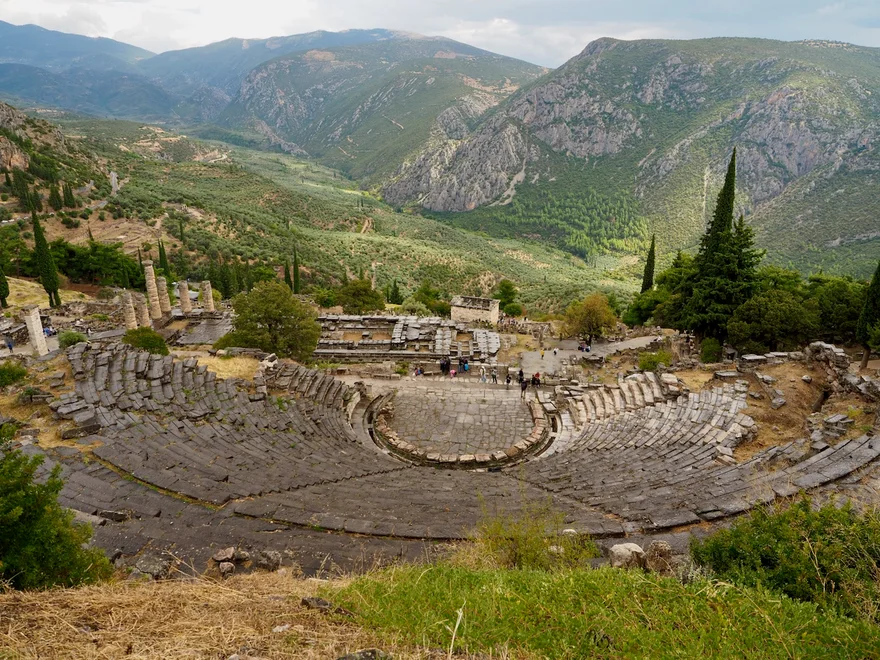
We walk uphill at Delphi, past the treasuries and the Temple of Apollo, towards the theatre and stadium. The audio guide tells us about gods and goddesses, about people who came here looking for answers. About the two eagles Zeus released from opposite ends of the world. Where they met was its centre. Delphi. The navel of the world.
The stories belong here. Among these columns and mountains, with this view across the landscape. We are impressed before we begin to ask why.
Then a span of time catches my attention: more than a thousand years.
Longer than a lifetime
For more than a thousand years, people came here. They consulted the oracle, brought offerings, built and rebuilt. There was music here, and athletic competition. The sanctuary’s significance changed over the centuries. But what a stretch of time.
I try to imagine the people behind that number. Someone working on a building that mattered before he was born. He will die; others will carry on. Long after them, people will still come here expecting something from this place.
The Greek gods fascinated me as a child. Their stories, their entanglements, their remarkably human failings. To me they were characters in books. The people who travelled to Delphi asked them questions on which their lives might depend.
I understand the difference. I cannot quite imagine what it felt like.
Yet the columns still stand before us. And the beauty of this place reaches us without our having to ask Apollo for anything.
Beginning what others will finish
As we walk on, I think of Europe’s cathedrals. Of the decision to begin one. Those who commissioned it could know they would never see it completed. Still, they began.
At Delphi, a sanctuary grew over generations. A single cathedral could take several lifetimes. What strikes me in both cases is the willingness to give a project that much time. Your own work would become part of it; eventually, your contribution might be almost impossible to distinguish.
What do you have to believe in to do that?
One answer is right in front of me: the divine. A temple, a cathedral — the endeavour was directed towards something beyond your own life. You could work for something whose significance did not end with your death.
At Delphi, cities also used their offerings and treasuries to display power and wealth. There was rivalry, pride, political ambition. But all of it had a place within a religious understanding that extended far beyond any individual life.
What stays with me is that it produced something whose beauty still moves us, although we do not share that faith.
What would sustain us now?
How would we justify such a project today? I think of costs, benefits, deadlines. Of when it will be finished and who will gain from it. Seen in those terms, a building we will not live to see completed sounds, first of all, like a challenge. A huge one.
What else would it take to make us want to begin?
Very little comes to mind. That unsettles me. I search for a contemporary building that makes me feel something similar. Somewhere people far in the future might still visit because it offers more than a glimpse of how we lived or worked.
My first thought is of concrete ruins. And yet we are standing among ruins ourselves. Here I see grandeur. In what we might leave behind, I initially see decay. It is not a fair comparison. What we encounter of antiquity is largely what survived and was preserved. Our own age has yet to be sifted.
Two buildings, no easy answer
I keep looking afterwards. The Sydney Opera House comes to mind. A building whose form reaches far beyond its function. It did not need a religious commission. Culture, architectural ambition and the desire to create something extraordinary can evidently sustain a project too.
Then there is the Sagrada Família in Barcelona. Here, people have worked on a single building across generations. Its religious origins remain part of its purpose. I go looking for another motivation and find myself back at faith.
And people of our own time are still building it. I cannot dismiss the Sagrada Família as the remnant of a vanished outlook simply because it began so long ago.
I struggle to find a third example that makes me feel the same. That need not mean such buildings do not exist.
Back on the hillside at Delphi
In my mind, I am back on the hillside at Delphi. With the people who built there, and with us, looking at what remains. Centuries separate us, as do ways of understanding the world that we do not share. Yet there is a connection. Their work still does something to us.
I do not know whether we lack a shared faith today. Nor do I know whether we would need one. But since Delphi, I have been wondering what might persuade us to begin something beautiful and leave its completion to people we will never meet.
The question has stayed with me. I could not put it to Apollo. His oracle fell silent long ago.