My rucksack is orange, with an aluminium frame. Angie’s also has a frame, though the colour is more discreet. We are travelling around the Peloponnese by bus and train, sleeping in a tent and cooking for ourselves. Our first big trip abroad. Greece, 1986.
In Kalamata, we step off the train into a city where we do not want to be on holiday.
About two weeks earlier, an earthquake struck. On 13 September, twenty people lost their lives. Houses were destroyed; many residents cannot return to their homes.
I no longer remember whether we had heard about the earthquake beforehand. We have been travelling for a while. Whatever we knew, we are not prepared for what awaits us.
Our first thought is to move straight on. But there is no further connection that day. Neither train nor bus.
We have to stay.
The walk to the campsite
Our guidebook describes a campsite at the far end of the beach and how to get there. What has happened since it was published is not in its pages. We will find out whether the site is open after the earthquake when we arrive. We set off on foot.
The route follows the beach. More than an hour with the rucksacks.
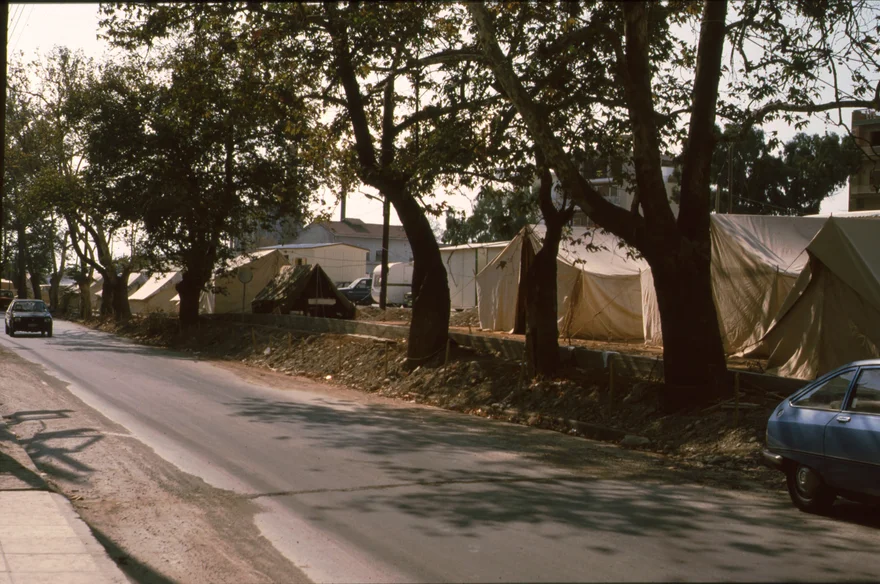
Large beige Red Cross tents stand along the shore. Tents everywhere. People whose homes are no longer habitable are living in them. Across the road stand the houses, marked with spray-painted colours. We later work out that these indicate which buildings must be demolished and which cannot, for now, be occupied.
We are walking to a campsite. The people beside us are living in tents too. There is nothing comforting about the resemblance.
We cross the road. We do not want to walk right past them with our rucksacks and our holiday. On the other side, we are closer to the damaged houses.
That image has stayed with us. The beige tents on the beach, the houses opposite and the road between them. For forty years, as vivid as almost anything we remember from our travels.
Someone is pleased to see us
The campsite is open.
The owner greets us with a beaming smile. Warmly, effusively. After that walk, his delight takes us completely by surprise. We have felt out of place all the way. He seems happy we are here.
We are his only guests. He gives us a nice pitch under a palm tree, and we put up our tent.
We lie awake uneasily that night. Now, of all things, the palm tree worries us. What if there is an aftershock? Will it fall on the tent?
The next morning, we pack. Back along the same road, beside the beach, to the station. We want to move on. We cannot see a place for ourselves here as holidaymakers.
For us, it is one night. The people on the beach remain.
Kalamata again
Forty years later, we return. Partly because we want to see what became of the city. Kalamata has never been simply a name on a map to us. For us, that name still brings those tents to mind.
This time, the guidebooks make us curious about the city itself. They describe a modern Kalamata with generous public spaces, parks, cafés and a long beach right beside the city. A place where Greek daily life and a seaside holiday fit together. We would like to get to know it.
Kalamata was rebuilt after the earthquake. Newer buildings now shape much of the city; to us, it feels unusually modern for a Greek coastal town. Yet older houses stand among them, with balconies, tall windows and tiled roofs. Palm trees rise above the façades along the promenade. People stroll in the warm evening light; tables stand outside the cafés. We enjoy walking here.
We like how much room there is for life by the sea. The long beach belongs to the city, as do the bars and cafés along the waterfront road. You can walk, sit, look at the water and move on when you feel like it. The harbour and mountains frame the view. Kalamata feels lively and open, a city where we can imagine spending longer.
Where the tents stood in our memory, people now spend their leisure time. So do we.
As we walk, the old picture returns. It has barely changed in our minds, while forty years have passed here. People repaired houses, built new ones, carried on living. We saw none of that. Between our two visits lies the rebuilding of a city.
We do not know the losses behind today’s façades. But we can see how much life there is. For the first time, Kalamata is also somewhere we would happily come on holiday.
At the end of the beach
The next morning, we go for a run. We want to see whether the campsite still exists. We know where to look: at the end of this long beach.
And we do find a campsite there. In our memory, only the road separated it from the sea. Now it sits back behind a restaurant with a seafront terrace. Beach clubs line the shore towards town.
We stop at the entrance barrier. We do not know whether it is the same site, or whether the same family runs it. It looks different from our memory. But where we think our campsite was, there is one.
The tents on the beach will remain part of our memory of Kalamata. The city of today now stands alongside them. We have another picture of the place, one we would gladly return to.
And then there is the man at the campsite. We do not know what became of him. But for forty years, we have never forgotten how pleased he was to see us.