As a child, I devoured Gerhard Aick’s “Die schönsten Helden- und Rittersagen des Mittelalters” — a collection of medieval tales of heroes and knights. Over and over again. I practically lived at Arthur’s Round Table. Merlin was my hero. And when Parzival, better known to English readers as Percival, finally asked the question that freed the Grail King from his suffering, I was deeply moved. At ten, though, I did not really understand the doomed love between Lancelot and Guinevere.
Fifty years later, Angie and I drive to Tintagel, the supposed birthplace of King Arthur. Angie has no childhood history with him. For me, he belongs to a world I have not visited for decades but can apparently still picture quite clearly.
Tintagel was not somewhere I had longed to visit. In my mind, the legend had not even belonged to a particular place. Nor had I expected to find an intact castle, let alone a Round Table. I knew from the guidebook that there were ruins to see.
What I had not noticed until then was how specific the setting in my imagination was. Shining armour, squires, women in flowing gowns, feasts in great halls. Somewhere in the late Middle Ages.
As we cross the bridge to the ruins, that picture suddenly no longer fits. There had been a settlement here many centuries earlier. And it is to that much earlier period that Arthur would have to belong, if he existed at all.
I had known I was reading a legend. But apparently I had never thought about when it was actually set.
When was Arthur?
I try to work out which period Arthur belongs to. And quickly realise that even this question is harder to answer than I had expected.
If there was a historical Arthur, he probably lived in the late fifth or early sixth century. Roman rule in Britain had ended, different rulers were fighting for power, and Anglo-Saxon groups were settling and extending their territories. In that world, Arthur might have been a military leader who fought against them. There is no historical evidence for a king who united the country. Whether a single person lies behind the figure at all remains an open question.
It is a strange discovery. As a child, I had known quite a lot about Merlin, the Round Table and the Grail. Yet surprisingly little can be said with certainty about the man at the centre of it all.
In a ninth-century text, Arthur appears as the victorious leader in twelve battles. Other early traditions connect him with superhuman deeds and a world of wonders. From here, though, there is no clear line we can trace to the book in my childhood bedroom. Over centuries, stories are told, expanded and pieced together anew. Much of that process can now only be guessed at.
A world with many authors
In the twelfth century, the picture suddenly becomes more vivid. Above all through Geoffrey of Monmouth, a cleric writing a history of the kings of Britain. In his account, Arthur makes a grand entrance: a powerful king and conqueror, set within a past stretching far back in time. Geoffrey also tells how Merlin gives Arthur’s father Uther the appearance of another man. This allows Uther to reach that man’s wife, Igraine. The place where Arthur is conceived in this story is Tintagel.
Geoffrey presents this as British history. Much of it, however, is literary invention or a reworking of older traditions. His account becomes extraordinarily successful.
And it keeps growing. The poet Wace retells the material in French and introduces the Round Table. Chrétien de Troyes makes Lancelot’s love for the queen into a major story and writes about Perceval and a mysterious grail. In the German-speaking world, Wolfram von Eschenbach develops his Parzival from this material. The question that moved me so much as a child finds its place here too.
The world I had felt at home in while reading had, it turned out, quite a few authors. And periods. They wrote in different languages, lived in different countries and held rather different ideas about what makes a hero.
Their world of knights was the world of their own time: courtly manners, tournaments, great love stories and Christian ideals. Later storytellers and images added further layers. In my mind, all of this had become a single era.
My picture fitted the stories. It was just that several hundred years separated that world from the time of a possible Arthur.
A castle for the story
Then our reading takes us back to Tintagel.
In the thirteenth century, Richard of Cornwall had a castle built here. By then, Geoffrey had made the site’s association with Arthur well known. That was probably a major reason for building on this exposed rock in particular.
We need a moment to get this straight. There was an early medieval settlement here whose inhabitants had far-reaching trading connections. Centuries later, an author made the place the setting for Arthur’s conception. Later still, a powerful man had a castle built here, probably in part because of that story.
Alongside the scant remains of the early settlement stand the ruins of this later castle. We visit both in the same place. But the castle itself already dates from a time when other people were fascinated by Arthur’s story.
What remains of the story
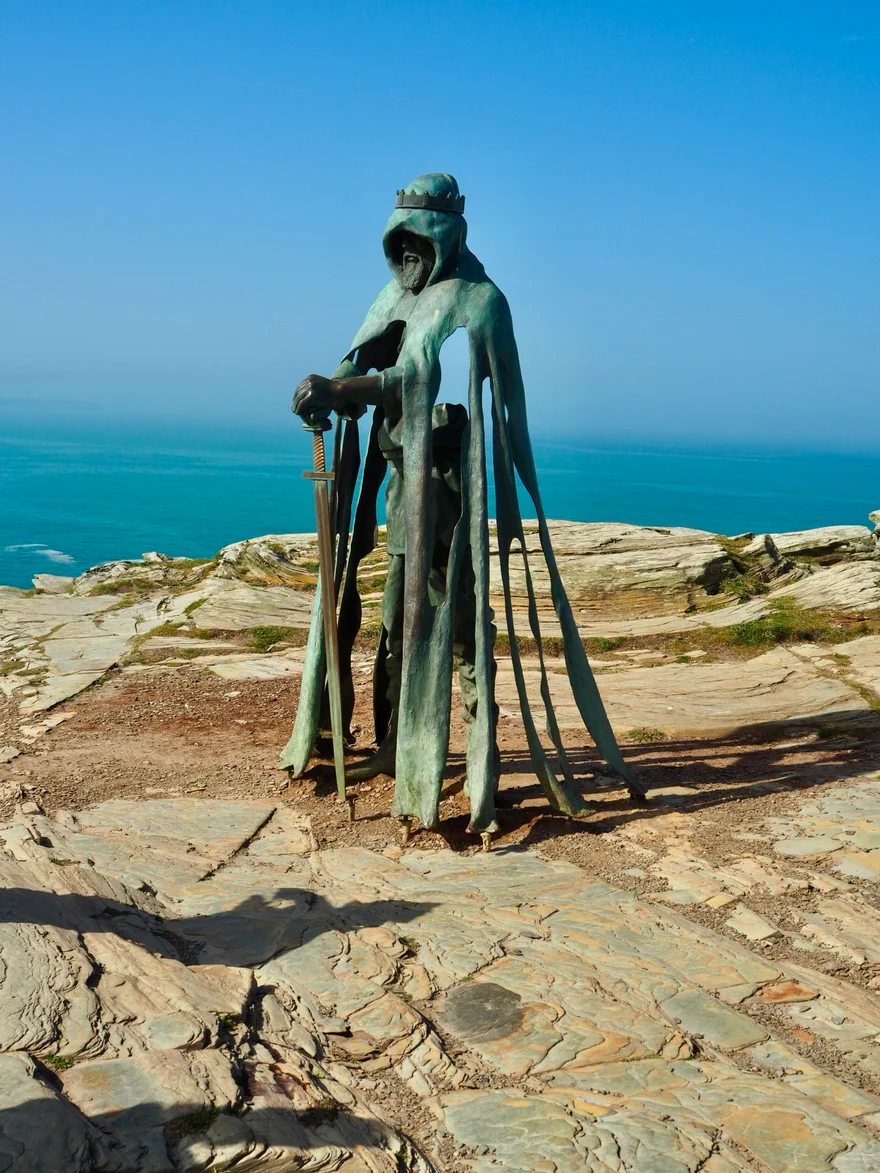
I think again of the figure on the cliffs at Tintagel. The crown, the lowered face, the hands resting on the sword. The sea behind him. However little we may know about a historical Arthur, here we recognise him at once.
As a child, his story seemed finished to me. Of course I knew I was reading legends. But the world between the covers was complete. Arthur belonged at the Round Table, Merlin at his side, Parzival on the quest for the Grail. It would never have occurred to me that these stories had come into being at different times. That people in different countries had kept writing them for centuries.
Now I know a little more about it. It has barely changed my memory of reading them. Merlin still fascinates me. And Parzival finally asking about another person’s suffering still moves me, fifty years on.
Perhaps that partly explains why these stories have stayed with me for so long. Parzival initially fails precisely because he follows what he has been taught: a knight should not ask too many questions. He wants to behave properly and fails to ask about the suffering of the person before him. Lancelot loves the wife of the king to whom he owes his loyalty. His love and his knightly honour cannot be reconciled.
As a child, this world seemed complete to me. Apparently it was never free of contradictions.
Perhaps that, too, has something to do with the many people who kept writing it over the centuries. With their different ideas about love, loyalty and what makes a good person. In the stories, those ideas collide. And even the greatest heroes do not always find a way to do them justice.
I could not say exactly what I took from Arthur and his knights as a child. But when I realise in Tintagel how little I knew about the origins of this world, I also notice how long it has been with me.