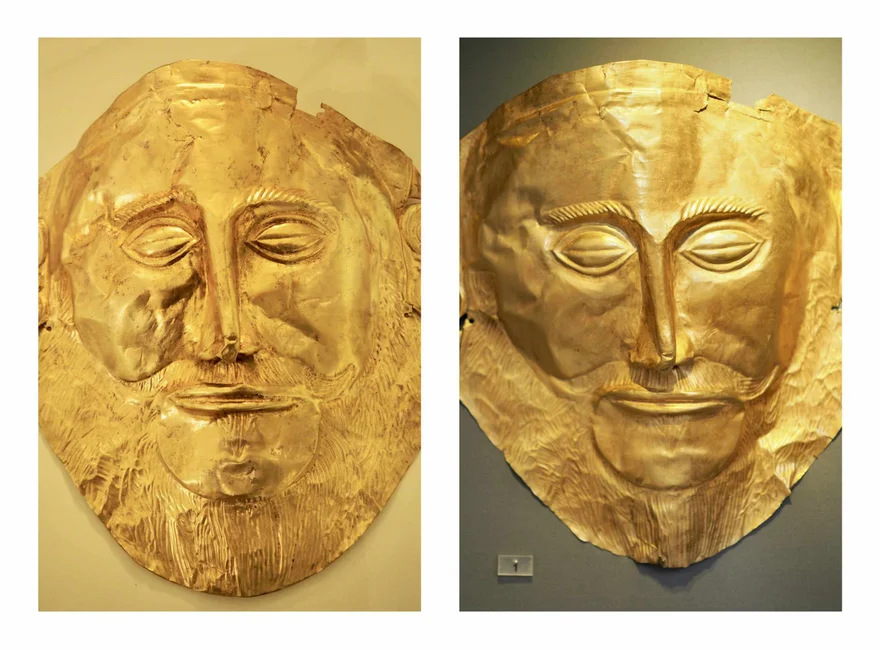
In the museum at Mycenae, we stand before the Mask of Agamemnon. Gold, closed eyes, a carefully worked beard. A face we know from countless pictures.
Angie has read that the mask on display is a copy. The original is in the National Archaeological Museum in Athens. I explain that, as non-experts, we would not be able to tell the difference anyway. Certainly not with the work of a famous restorer. Angie says, “We’ll have another look in Athens.”
I know nothing about archaeological reproductions. Apparently, that is no obstacle to an explanation.
Angie photographs the mask and sends it on WhatsApp to a former colleague interested in antiquity. He replies: “The so-called Mask of Agamemnon.”
Two experts, not a clue
Nearly two weeks later, we stand before the original in Athens. Angie takes another photograph and sends it to her colleague. Later, when she sees the little thumbnail from Mycenae beside his reply, she says, “That looks different.”
I explain why. The light. The material. Its state of preservation. The same object can look very different in two photographs.
Angie asks Claude. The AI gives much the same explanation. We now have two expert opinions in agreement. What qualifies either of us as experts is a question we leave aside.
Angie opens both pictures at full size.
The brows, the cheeks, the beard: the Athens original looks simpler, more schematic. The cheeks form broad planes. In Mycenae, the face is more sculpted, particularly around the mouth and chin. The closer we look, the less remains of my explanation.
Angie keeps asking, this time ChatGPT. A name comes up that we follow: Gilliéron. Suddenly, the famous restorer himself becomes interesting.
Original — or a little more original?
Émile Gilliéron, a Swiss artist and archaeological illustrator, worked for Schliemann and later for Arthur Evans at Knossos. Together with his son, also Émile, he ran a successful business reproducing ancient art. Major museums were among their customers. The reproductions at Mycenae also trace back to his work.
The Gilliérons offered two versions of the mask. One showed it in its surviving condition. The other showed how they thought it might originally have looked. To achieve that, they reworked forms taken from the original.
In a sense, you could choose: the mask as it had been found, or the mask as it was supposed to have looked before the damage.
I look again at the original. Its simple features do not strike me as needing extra expression. Why should the face originally have been more lifelike? This time, I have no explanation.
Comparing it with the documented reconstructed version at the Metropolitan Museum, we recognise the features of our mask from Mycenae. There is much to suggest that it follows this version.
Angie had seen a difference. I had assumed there could not be one. My argument about quality was precisely the problem: an excellent restorer can also be an excellent interpreter.
We knew the mask in Mycenae was a copy. The exhibition had not made it clear to us that it also embodied an idea of the original appearance.
Antiquity, a family business
The Gilliérons are worth staying with a little longer. At the Palace of Knossos on Crete, father and son also reconstructed wall paintings. One shows the so-called “Priest-King”: a bare-chested man with a magnificent feathered crown. What had actually been found, however, were fragments of a painted wall relief. The Gilliérons assembled them and supplied the missing parts.
Whether those fragments belonged to the same figure at all is disputed. The feathered crown, for example, may have belonged to a sphinx. Remains of several figures may thus have become a single supposed ruler. You cannot tell from the finished picture. There stands a man with a crown. Looks right.
A few fragments leave questions open. A complete figure answers them before we have asked.
Photoshop, museum-approved
At this point I think of Photoshop. Altering contours, smoothing imperfections, giving a face more expression. On Instagram, my suspicions would probably wake up sooner. In a museum case, the word “copy” is enough to make me feel informed.
The Gilliérons wanted to recover lost forms. That is a different ambition from a beauty filter. Yet here too, we see a face shaped by an idea of how it ought to look. The finished face does not tell us where the find ends and imagination begins.
I would have liked to see both versions side by side, with an explanation of where the restorer intervened. Surely that would be fascinating: watching a damaged object become a face again, and seeing where conjecture enters the process.
Instead, Angie first had to argue her way past her husband and an AI.
So-called
There is still her colleague’s message. “The so-called Mask of Agamemnon.” The name too promises more certainty than we possess. The dead man’s identity is not established. The mask dates to the sixteenth century BC, several centuries before the period usually assigned to the Trojan War. But a famous king is naturally more interesting than an unknown bearded man. Heinrich Schliemann had a gift for marketing.
I am no Schliemann. But I too managed a convincing explanation without enough evidence. Twice.
Fortunately, Angie looked anyway.